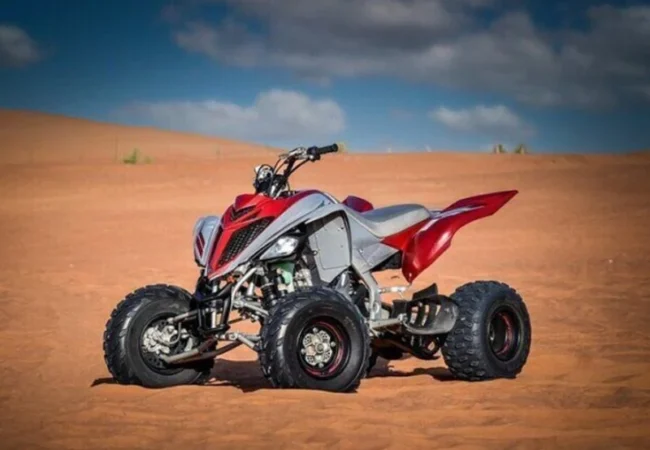
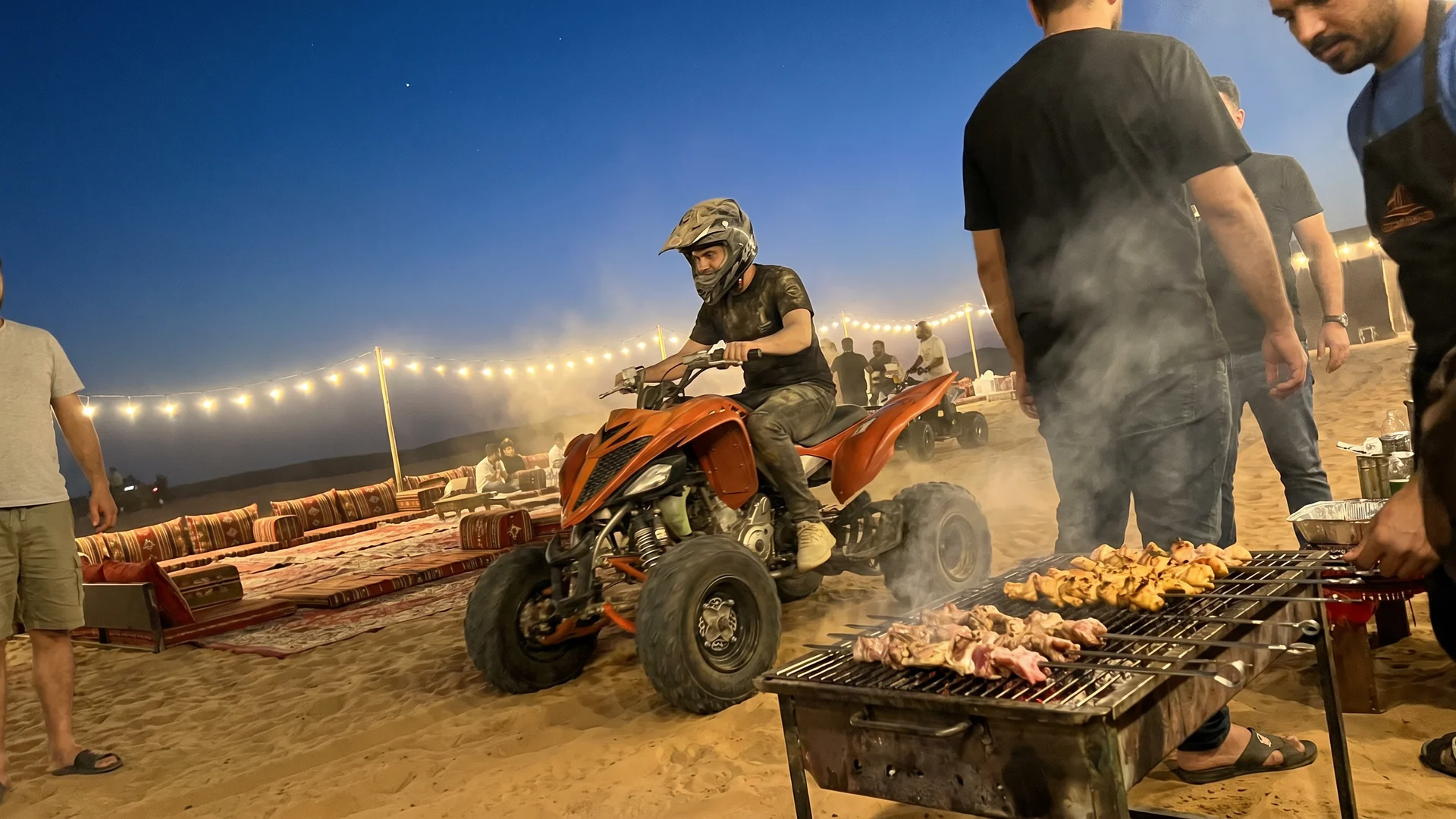
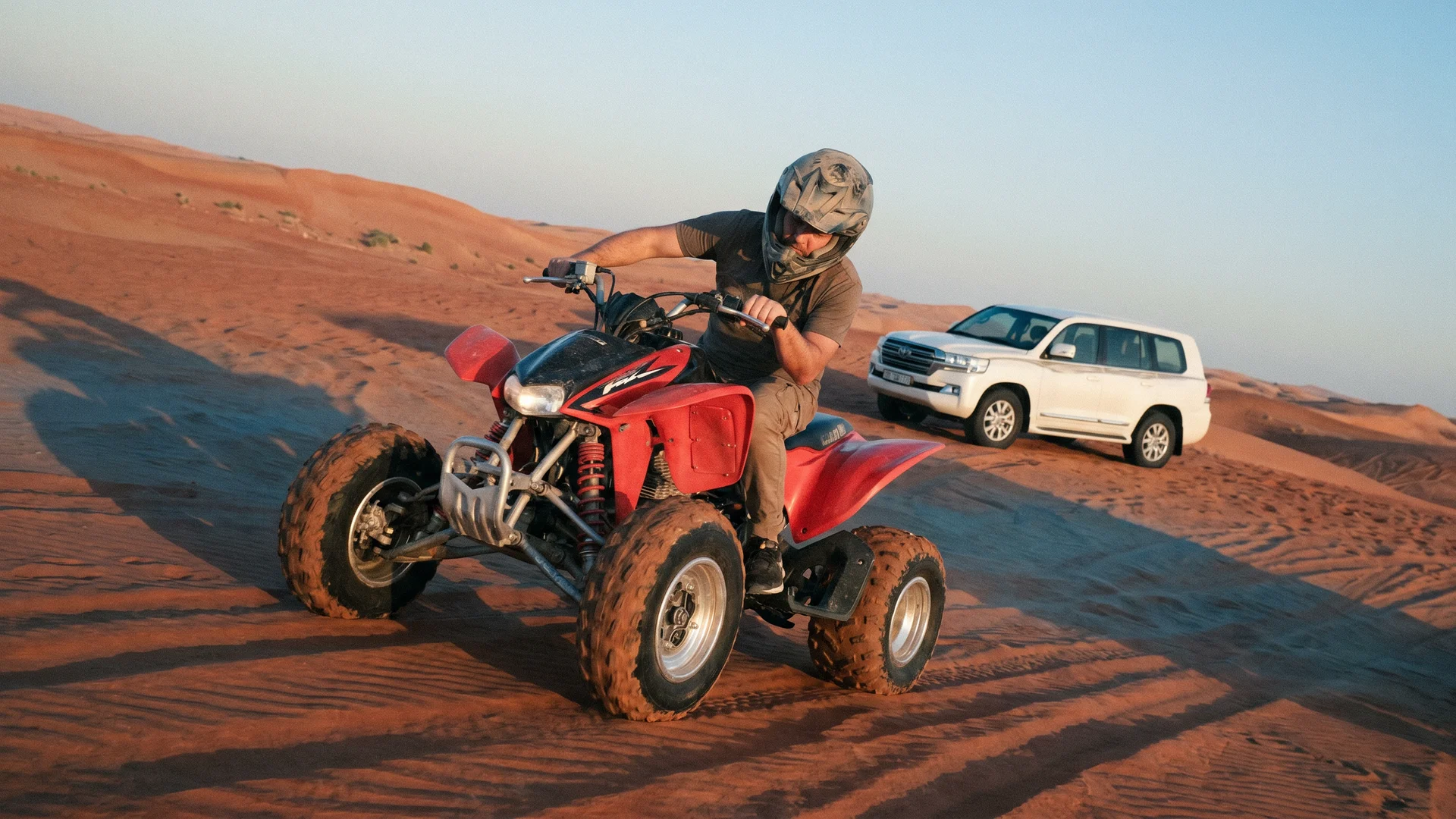
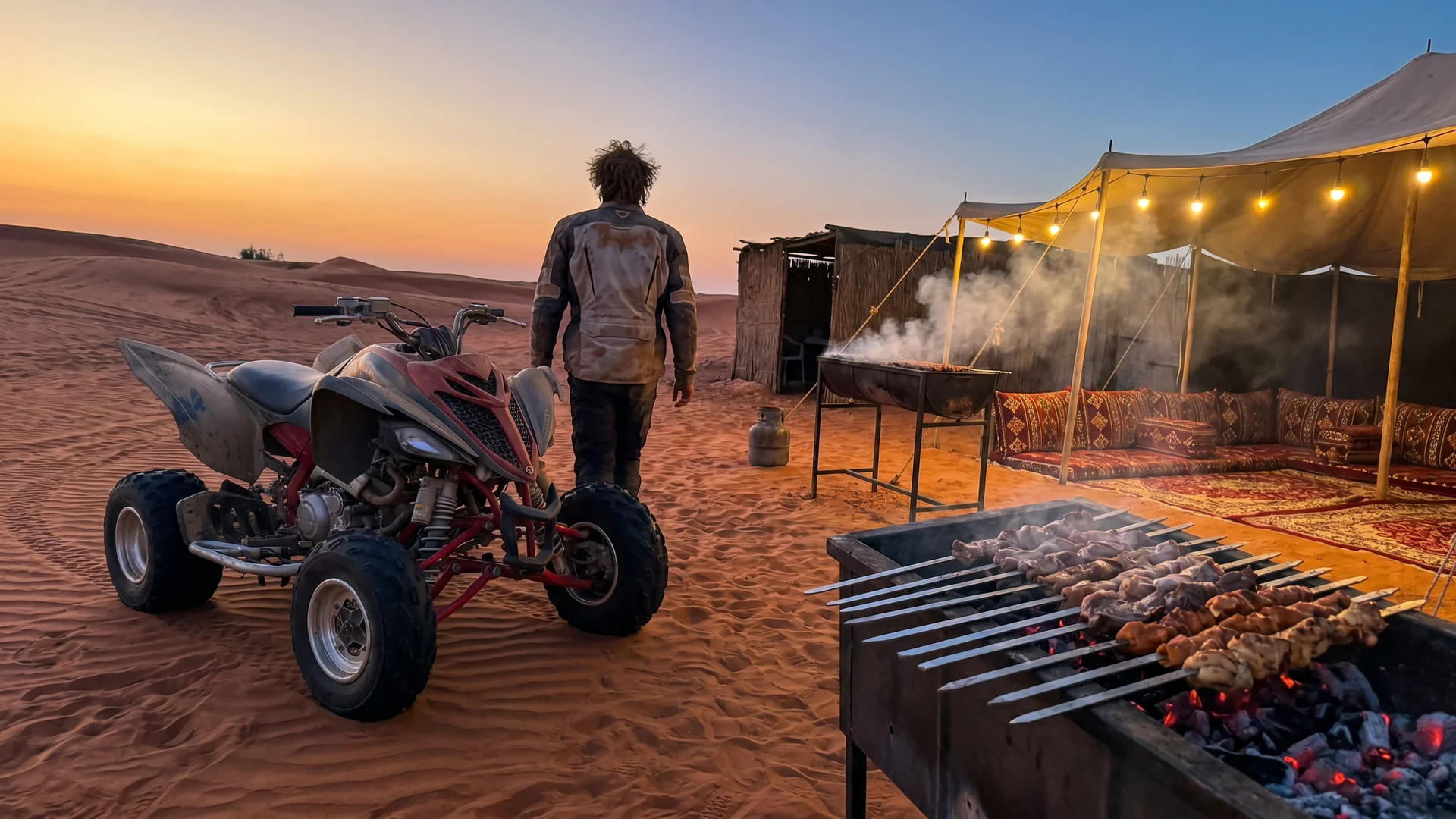
How exposed are you to sand and dust on a quad, compared with sitting inside a buggy's cage?
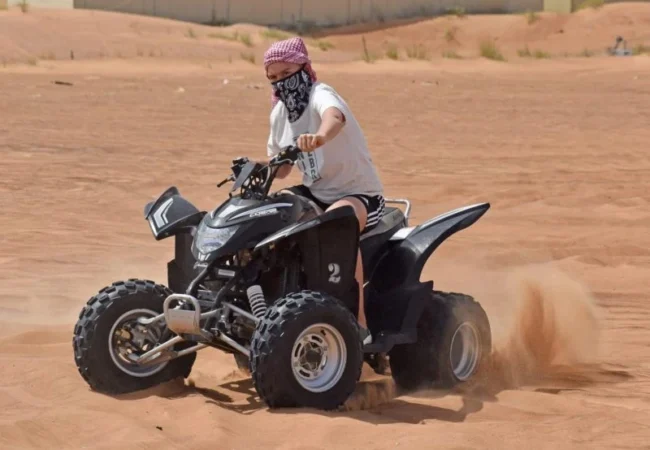
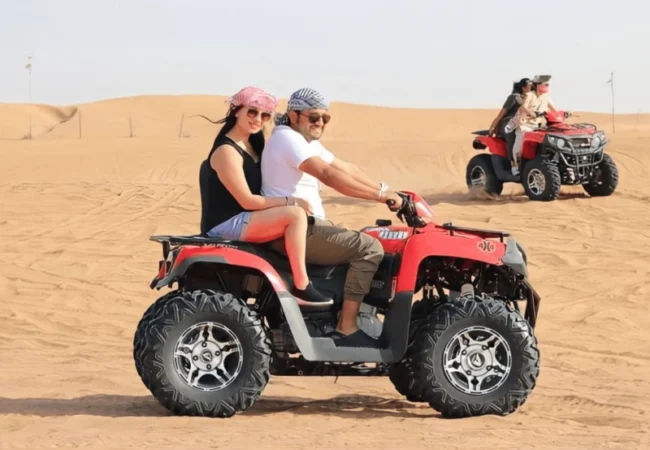
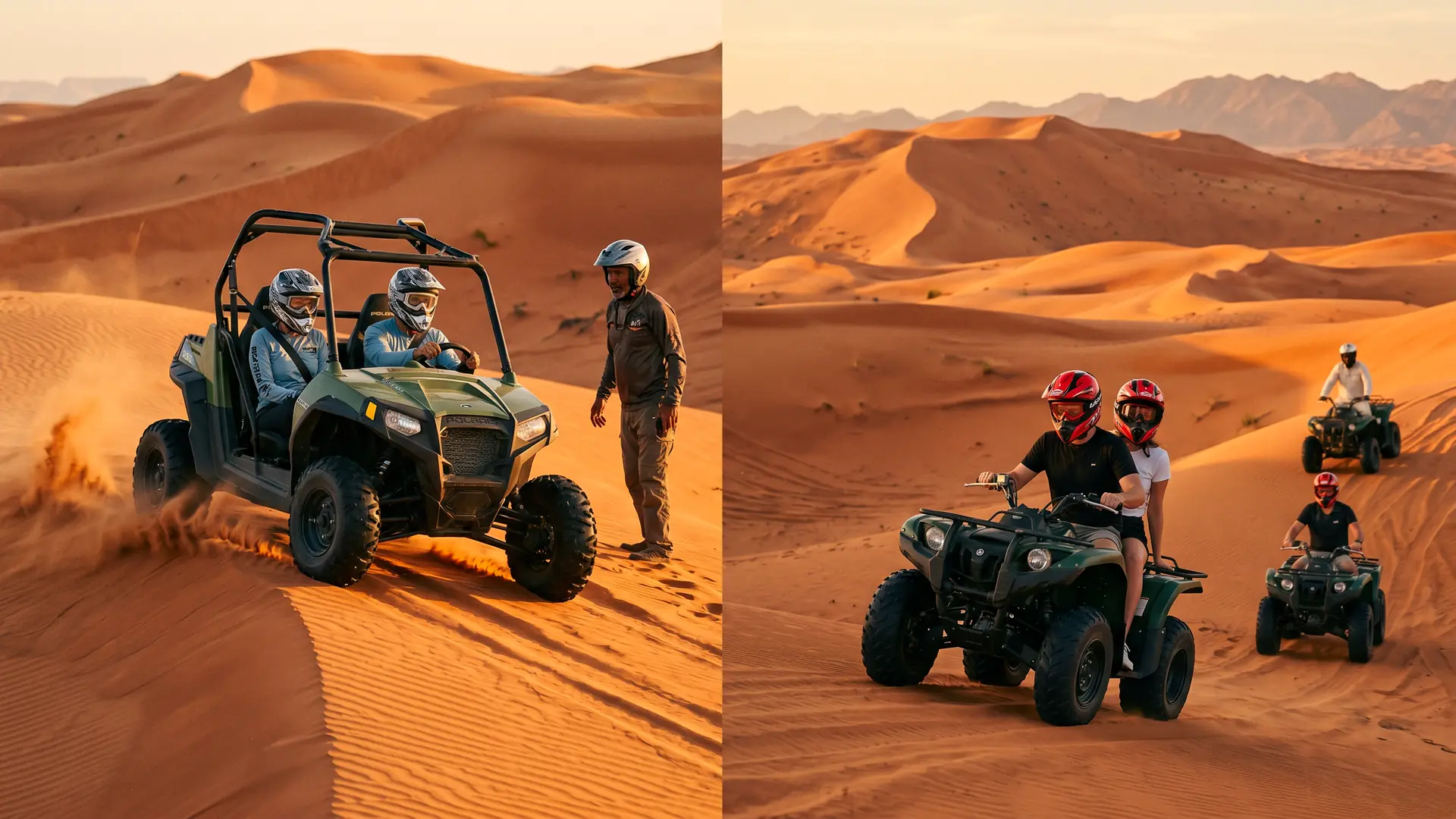
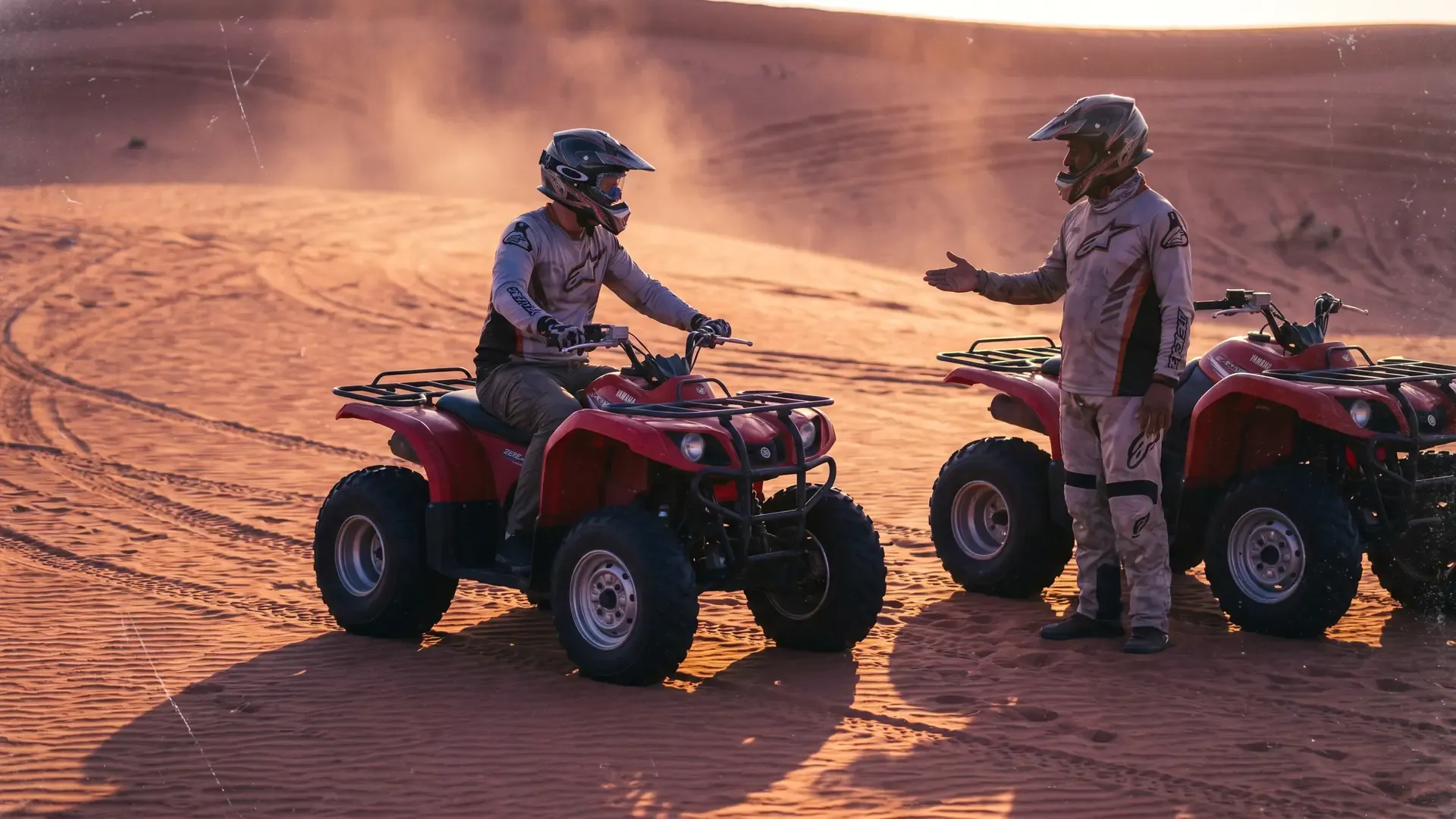
Directly and immediately. A quad rider sits in the open with nothing ahead but the handlebars, so dust from your own front wheels, or from whoever is riding ahead of you, reaches your face and arms within a second or two. A buggy's roll cage and windscreen block a real share of that before it ever gets near the driver.
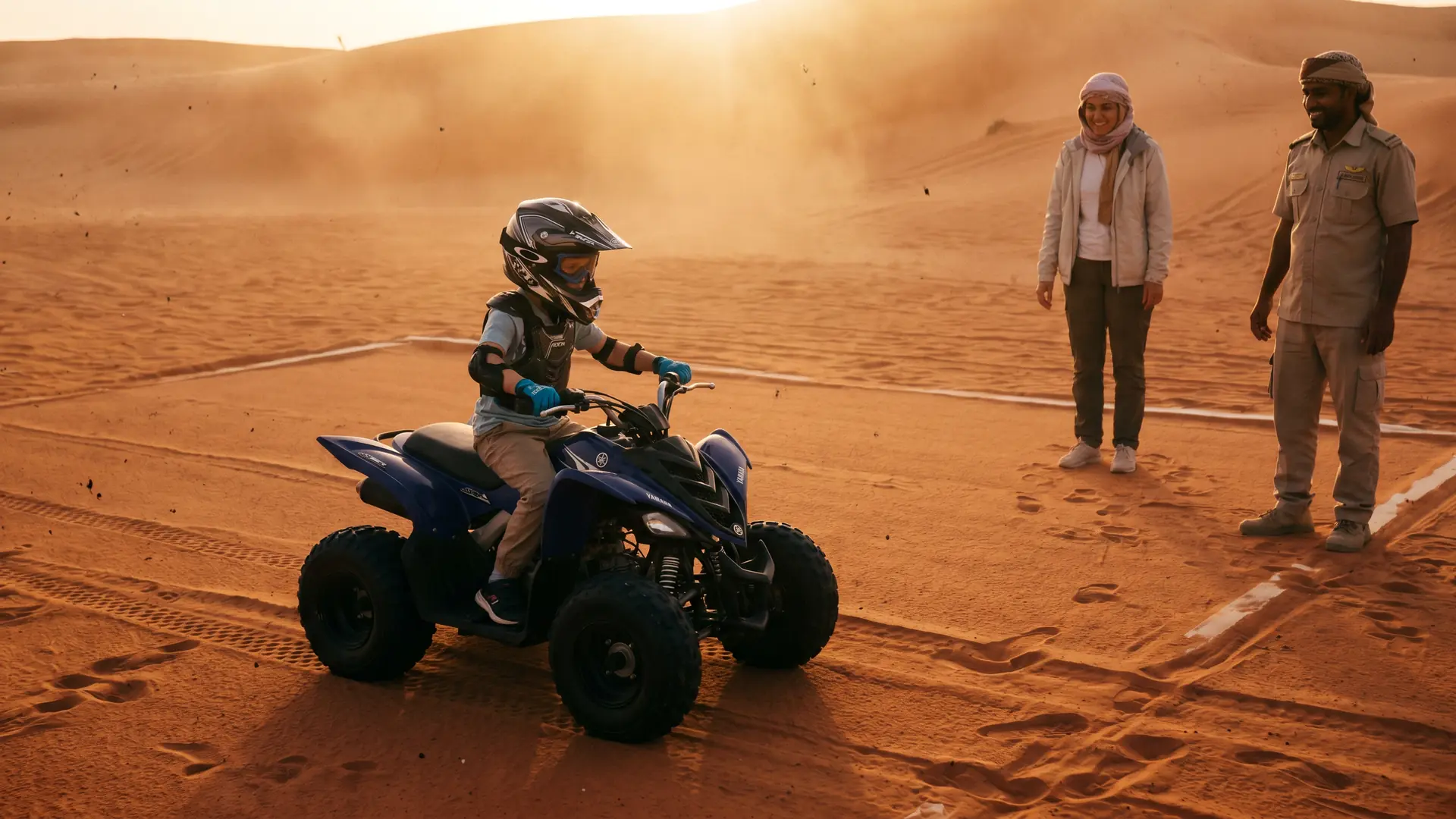
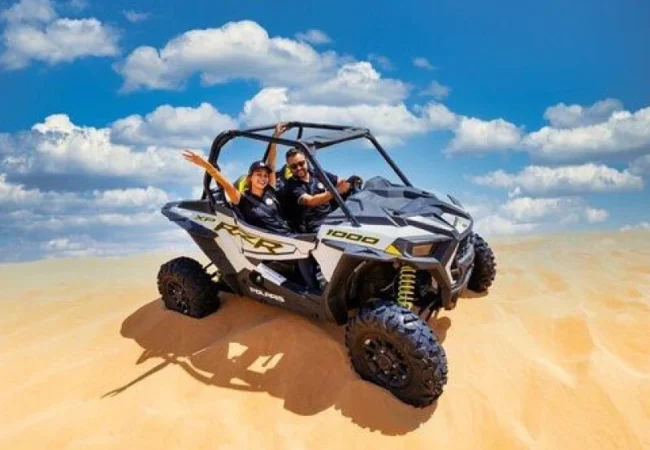
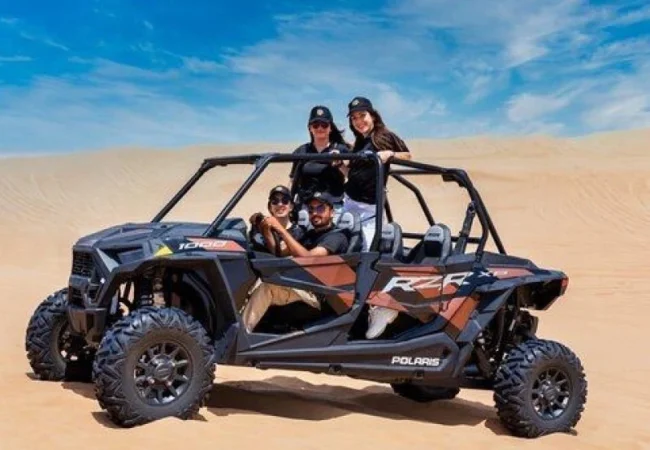
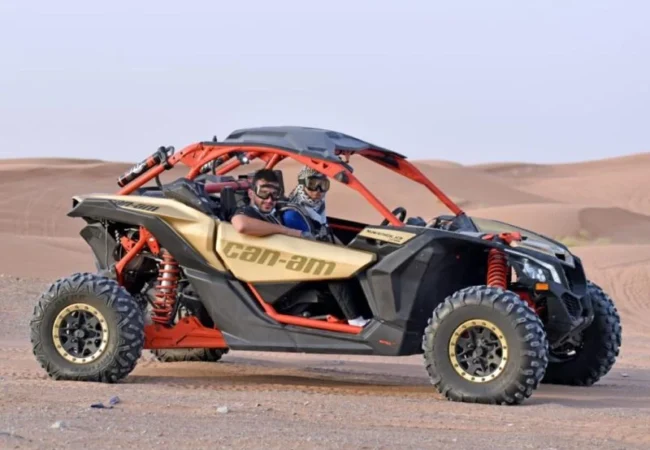
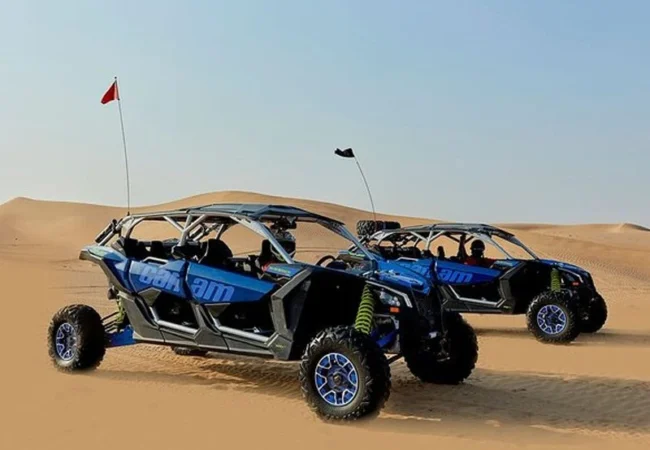
A buggy on this fleet puts its driver behind a low windscreen, inside a roll cage, with a frame on either side. However much dust a session throws up, a real share of it deflects around that structure rather than through it, which is one reason a buggy passenger can finish a session looking noticeably cleaner than a quad rider covering the same ground. A quad offers none of that shelter. You sit astride the machine with your hands on the bars and open air on every side, so whatever the front wheels kick up, or whatever the rider ahead of you throws back, reaches you close to instantly.
That single difference is why quad riders get spaced out further than buggies do during a session, part of the standard safety setup on every booking here. Riding close behind another buggy barely registers for the person following. Riding close behind another quad means eating their dust trail for however long you hold that position, which is uncomfortable rather than dangerous, but uncomfortable enough that guides build the gap in from the start rather than waiting for someone to ask for it.
Across a full session the effect is cumulative rather than dramatic. Sand works into anywhere clothing gapes at the wrists or collar, a gritty film builds on exposed skin, and your mouth dries out faster than it would riding the same route boxed inside a cage. None of it is a reason to hesitate. It is simply a different physical experience than the one a buggy gives you, and worth knowing before you choose between the two on a first visit.
A buff or light scarf pulled up over the nose and mouth solves most of this cheaply, and plenty of returning riders bring one from home once they know what a session actually feels like. First-timers usually only work this out halfway through their first ride, which is a fine way to learn it, just a dustier one.
Why does a quad let you feel a dune ripple or a soft patch that a buggy would smooth right over?
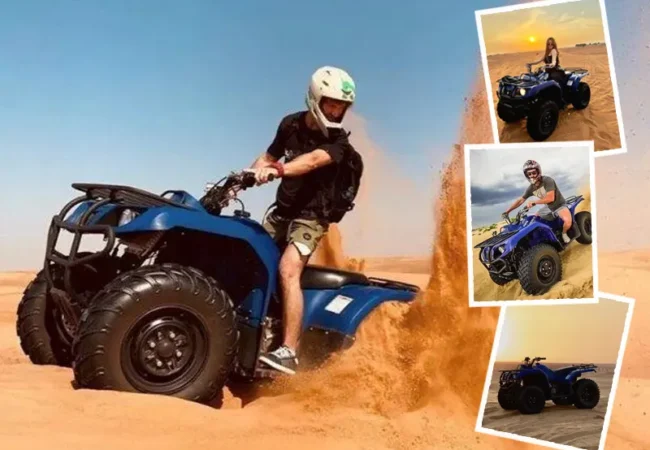
Shorter suspension travel and a riding position directly over the front wheels. A buggy's long-travel suspension is built to absorb rough sand before it ever reaches the seat. A quad passes far more of that texture straight through to your hands, knees and feet.
A Can-Am or Polaris on the buggy side of this fleet runs long-travel suspension built specifically to swallow rutted, wind-cut ground, which is exactly why a passenger can cross broken sand and barely register it through the seat. A quad's suspension travels a fraction of that distance. There is less material between the wheel and your body, so a ripple in the sand, a sudden patch of looser grain, or a rock hiding under the surface all arrive through the bars and the footpegs almost as they happen, rather than smoothed out on the way to you.
This is not a design flaw, it is most of what makes riding a quad feel different from driving a buggy in the first place. You sit astride the machine rather than strapped into a bucket seat, which means your knees, hips and the balls of your feet are doing constant, small work reading the ground and adjusting your weight before you consciously decide to. Guides watch for this during the warm-up circuit, checking whether a rider's body moves with the terrain or fights it, because that one habit predicts more about how the rest of the session goes than engine size ever does.
The upside is a level of feedback a buggy simply cannot offer. Experienced riders describe feeling a dune face change consistency a half-second before the front wheels actually confirm it, purely from the vibration coming through the bars. First-timers do not have that instinct yet, which is exactly why the 220cc and the 400cc are built to forgive a delayed reaction, giving you time to catch up to what the sand is already telling you.
How much sun do you actually take on a quad with no roof overhead, and does that change what time you should book?
All of it, for the whole session, since a quad has no roof, no windscreen and no shade of any kind. That makes the booking slot matter more for a quad rider than it does for most other activities on this page.
A buggy's roll cage throws at least some shadow across the driver depending on the sun's angle, and the frame itself blocks a portion of direct light for anyone sitting low in the seat. A quad offers none of that. You are out in full sun from the first minute of the warm-up to the last minute of the ride back, with nothing between your shoulders, forearms and the back of your neck and whatever the sky is doing that hour.
That single fact is why the booking slot matters more here than the choice of machine. A midday session in July puts a rider under direct sun for the better part of an hour with almost no relief, while the same hour at 7 AM or in the last stretch before sunset delivers a completely different level of exposure even though the ride itself covers the same ground. The evening safari and quad combo exists partly for this reason: by the time the quad session starts, the sun is already low enough that direct exposure has dropped off sharply.
Sunscreen reapplied before the session, a long sleeve over exposed forearms, and a buff or scarf across the back of the neck do more for a quad rider than they would for someone riding inside a buggy's shade, simply because there is more skin in direct contact with the sun for longer. None of this is a reason to avoid the middle of the day if that is the only slot available. It is a reason to treat sun protection as part of the kit, the same way a helmet is, rather than an afterthought you deal with back at the hotel.
How does wind hit a quad rider differently than someone sitting inside a buggy?
Directly and at speed, since there is no windscreen or door panel breaking the airflow first. A buggy driver feels wind mostly on the arms and face. A quad rider feels it across the whole body at once.
Sit inside a buggy and the windscreen, low door panels and roll cage all interrupt the air moving past you, so what actually reaches the driver is a reduced, redirected version of the real wind. A quad has none of that structure. Moving at the same speed across the same stretch of dune, a quad rider takes the full force of it across the chest, shoulders and helmet with nothing ahead to break it first.
On a still morning this barely registers. On a breezier afternoon, which is common in the warmer months, the combined effect of natural wind plus the wind a quad generates simply by moving can be enough to push a rider slightly off line on an exposed ridge top, something a heavier, wider buggy shrugs off without the driver even noticing. Guides account for this when they choose a route for the day, favouring sheltered lines through the bowls over exposed crest-riding when it is gusty, more for quads than for anything else in the fleet.
There is an upside to it too. Wind on a quad also carries heat away from your body faster than it does inside a buggy's more enclosed cabin, so on a hot afternoon the same airflow that pushes at your balance also does some of the work of cooling you down. It is a genuine trade-off rather than a downside on its own, and most returning riders end up preferring the open feel once they have adjusted to compensating for it.
Does the temperature swing from morning to evening matter more for a quad rider than for other activities?
Yes, because a quad rider feels the actual air temperature directly, with nothing insulating them from it. A buggy's cage and a Land Cruiser's cabin both blunt that swing. A quad does not.
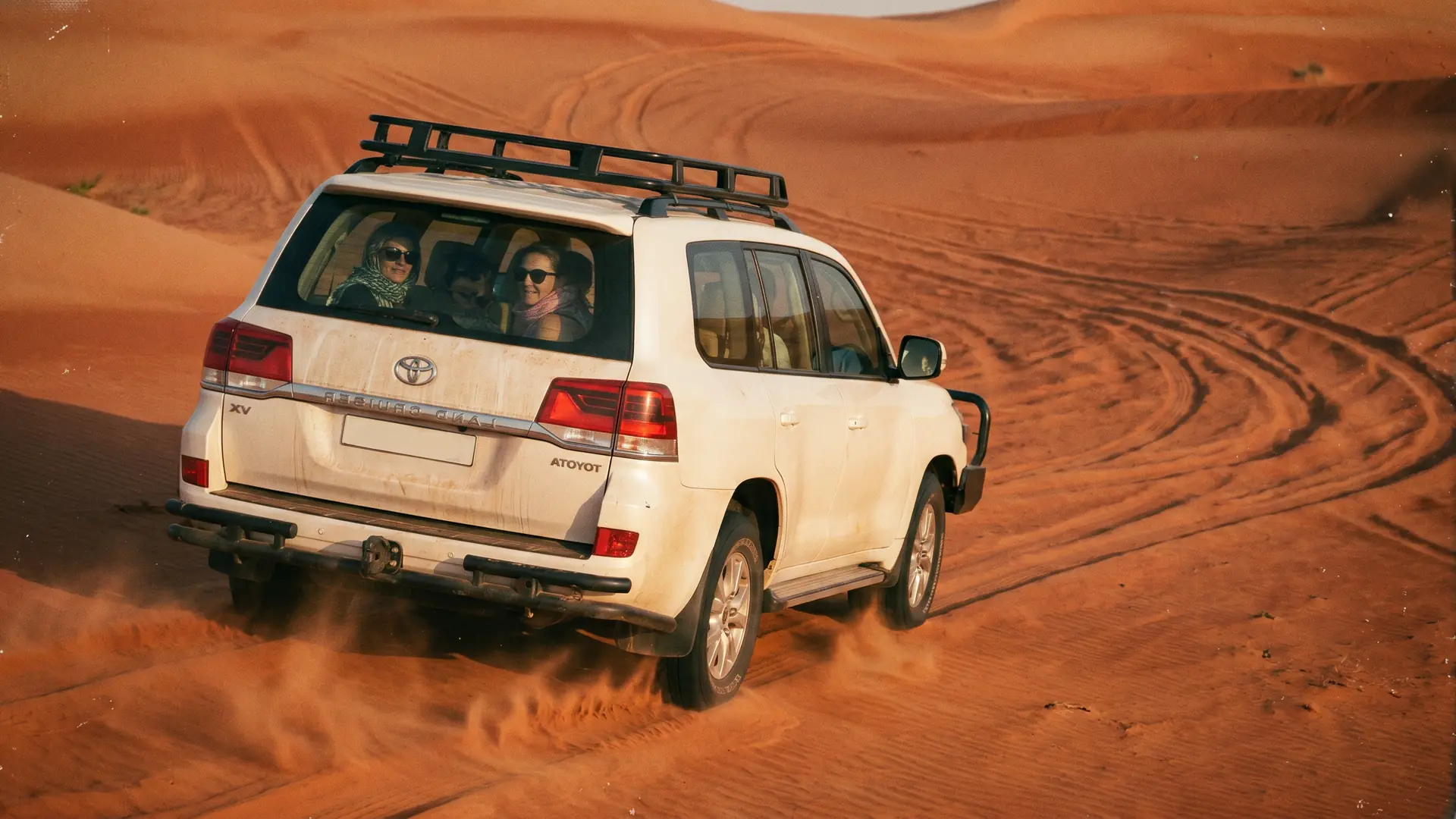
Dubai's desert can move from a genuinely cool morning to a hot mid-afternoon and back to a mild evening within a single day, and how much that swing affects you depends heavily on what you are sitting in. A safari passenger inside an air-conditioned Land Cruiser barely notices the outside temperature at all. A buggy driver feels some of it, filtered through the cage. A quad rider feels essentially the whole swing directly against their skin, since there is no cabin and no glass between you and the actual air.
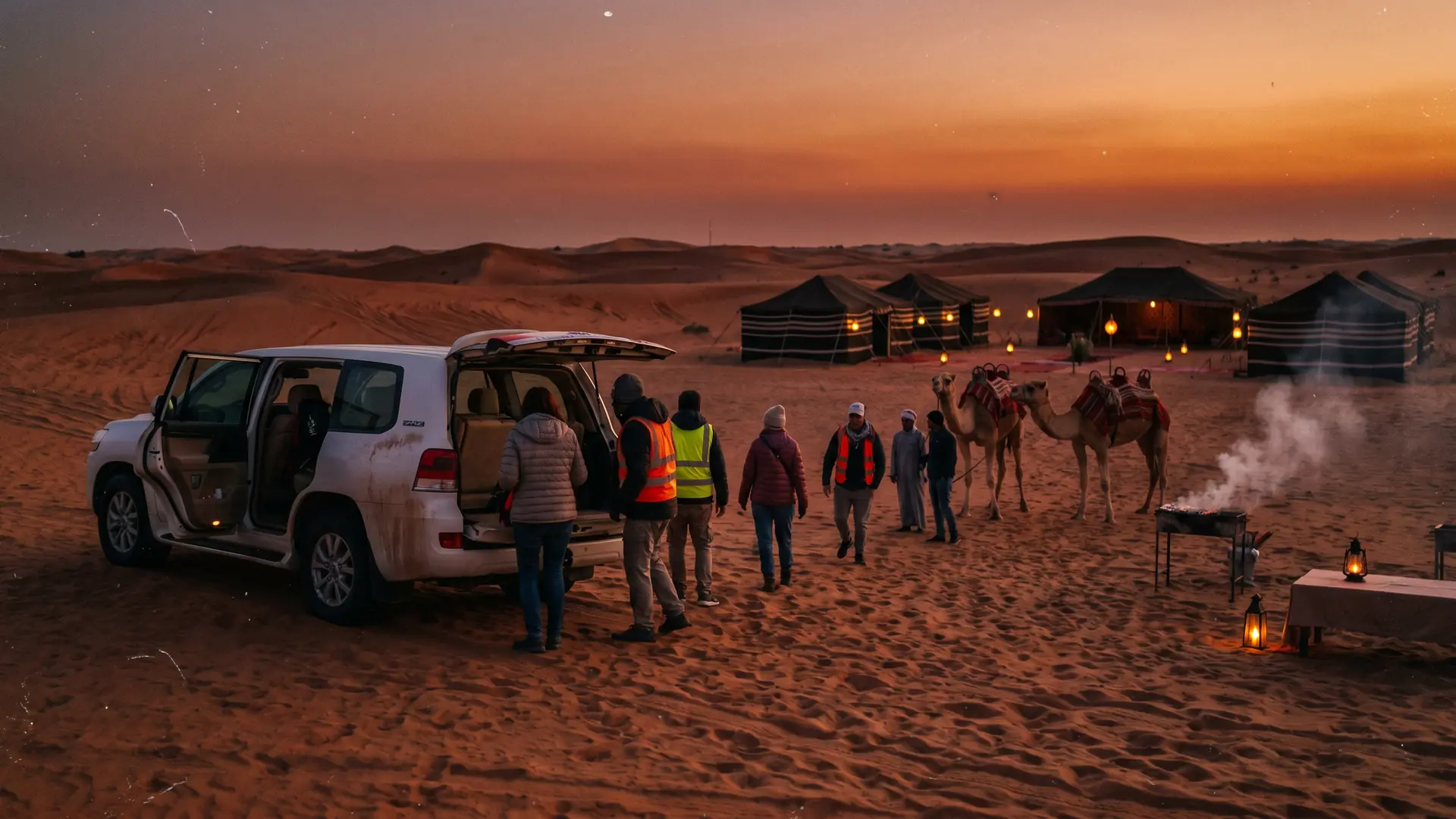
This is one of the more practical reasons the morning and evening quad sessions consistently outsell anything scheduled around midday between May and September. An early slot on the day's schedule means riding while the desert is still carrying its overnight cool, which on an exposed quad feels noticeably more comfortable than the same ride two hours later once the sand and the air above it have both been absorbing direct heat for a while. The evening safari, quad and BBQ combo works the same way from the other direction, timed so the quad session lands as the temperature is already dropping rather than during the day's hottest stretch.
Layering matters more here than most riders expect before their first session. A light long-sleeve layer that feels unnecessary at a cool 7 AM start becomes genuinely useful protection against both sun and wind an hour later, and it comes off easily if the temperature climbs faster than expected. Riders who dress for the temperature at pickup rather than the temperature they will actually be riding in are the ones who end up overheated, or under-dressed, by the final stretch.
What does a session through soft sand actually do to your arms, shoulders and legs, compared with firmer ground?
More than most first-timers expect, because a quad rider is working the whole time rather than sitting strapped in. Soft sand multiplies that effort, since the machine needs constant, active correction just to hold a line.
Riding a buggy is largely a seated, strapped-in activity. Your arms turn a wheel, your foot works two pedals, and a harness holds the rest of you in place while the suspension does the heavy lifting over rough ground. A quad asks far more of your whole body. You are gripping the bars, bracing through your knees against the tank, and shifting your weight forward, back or side to side almost constantly to keep the machine balanced and tracking where you want it to go.
Soft sand raises that workload noticeably. On firmer ground, low in the bowls where overnight moisture has compacted the surface, a quad tracks in a fairly straight, predictable line and correcting for drift takes light, occasional input. Climbing a loose, dry dune face is a different job entirely: the front end wanders more, the machine wants to squirm under acceleration, and staying on line takes continuous small corrections through your arms and core rather than the odd nudge firmer ground asks for.
By the end of a longer session, most first-time riders feel it first in the forearms and grip strength, then in the shoulders and lower back from the constant weight-shifting, and only after that in the legs from bracing through turns. It is a genuinely different kind of tired than a buggy session leaves you with, closer to what you would feel after an hour on a mountain bike than after the same hour spent driving. Anyone choosing between the smaller and larger machines is worth factoring this in, since more engine does not mean less physical effort, just a different kind.
Does the desert actually look different from a quad's saddle height than it does from inside a buggy?
Yes, in two ways: a quad sits you slightly higher and more upright than a low-slung buggy seat, and there is no roll cage, windscreen or door frame cropping the view in any direction.
A buggy seat sits low, wrapped by a roll cage overhead and a frame on either side, which gives a driver a specific, somewhat letterboxed view of the desert ahead. A quad puts you higher and more upright, straddling the machine rather than reclined into a bucket seat, with nothing structural in your peripheral vision at all. The practical result is a wider, less interrupted field of view in every direction, not just ahead through a windscreen.
That difference matters most at the top of a climb. A buggy driver's first view of what is on the other side of a ridge arrives filtered through a windscreen and a cage upright; a quad rider gets the same view completely unobstructed, with the added sense of actually being up on the ridge rather than sealed inside a vehicle parked on it. Guides often let quad riders linger a few extra seconds at a crest for exactly this reason, since the photo and the view both read differently from that height and that openness.
It changes closer to ground level too. Sitting higher and further forward than a buggy seat puts a quad rider's eyeline closer to where the front wheels are actually about to go, which is part of why reading a soft patch or a rut a second or two early becomes second nature faster on a quad than it does behind a wheel. Riders who have done both back to back consistently describe the buggy as the more comfortable way to see the desert, and the quad as the more immediate one, a distinction that shows up often in what riders write afterward.
People also search for
Guide FAQ
Does riding a quad feel more physical than driving a buggy?
Yes, noticeably. A buggy has you strapped into a seat while the suspension absorbs the ground. A quad has you actively balancing, gripping and shifting your weight the whole time, which is why an hour on a quad tends to tire out your arms and core in a way an hour in a buggy does not.
Should I wear sunglasses or goggles on a quad?
Something covering your eyes is worth having regardless of what you are told at pickup, since a quad throws sand and wind directly at your face with nothing to break it first. Wraparound sunglasses work for a casual session, and goggles are better on a longer route or a faster machine.
Does the exposed riding position make a quad harder to control than a buggy?
Not harder, just different. A buggy's wheel and pedals are a familiar control layout for most riders. A quad asks you to steer partly with your body weight, which feels unfamiliar for the first few minutes and then becomes intuitive once the warm-up lap gives you a feel for it.
Is a quad session more tiring in summer because of the exposure?
It can be, which is exactly why summer quad slots move to early morning or the hour before sunset rather than midday. Riding fully exposed to direct sun for an hour in July feels very different from the same hour in December, even on an identical route.
Can I bring my own gear to deal with sun, wind and dust?
Yes, and returning riders usually do. A light long-sleeve layer, a buff or scarf for your face, and sunscreen applied before the briefing all make a real difference on a quad specifically, more than they would for a buggy or safari booking.
Does riding behind other quads mean riding through their dust the whole time?
No. Guides space quad riders out for exactly this reason, and the gap used is wider than what buggies run in a convoy. You will still catch some dust on a dry, windy day, but not a constant trail from the rider ahead of you.
Why does a quad feel bumpier than a buggy on the same dune?
Shorter suspension travel and a riding position directly over the front wheels. A buggy's long-travel suspension is built to smooth out rough sand before it reaches the driver. A quad passes more of that texture straight through to the rider, which is part of what makes it feel more connected to the ground.
Is the Raptor 700cc more exposed than the smaller quads?
Exposure is the same across the whole fleet, since none of the machines have a cage or a windscreen. What changes on the Raptor is speed, so wind and dust arrive faster and with more force, one more reason it gets screened before anyone is handed the keys.
Does sitting higher on a quad make the ride feel more intense?
Most riders say yes. A quad's more upright seating position and open sightlines make speed and dune drops feel more immediate than the same manoeuvre would from a lower, caged buggy seat, even at a comparable pace.
Is the physical side of quad riding a reason to book a shorter session first?
It is a reasonable approach if you are unsure how your arms and grip will hold up. Sessions are arranged per group rather than fixed to one length, so it is worth mentioning at booking if you would rather start shorter and judge how you feel before adding a combo on top.
 AED 150